

In the spring of 1972, my mom Beatriz and I returned to Miami after deplaning a Colombian airliner, to begin a new life in the United States after living in Bogota for nearly five years. We’d left Miami in 1967, two years after my dad, Jeronimo, died in a plane crash near the Miami International Airport (MIA) in February of 1965.

My mom hadn’t planned to move to Colombia, but my grandparents didn’t think Miami was a good place for a young widow to live alone with a disabled toddler with cerebral palsy. “At least you’ll have the rest of the family to help you,” my grandfather said. Mom couldn’t argue with the logic of this statement, so off we went to the teeming city in the cold, high Andes Mountains.
Although Mom’s social position allowed her to co-own a successful restaurant with her brother Octavio and provide my older sister and me a comfortable lifestyle, we didn’t stay in Colombia permanently. A short time after my ninth birthday, I suffered from an intracerebral hemorrhage that sent me to the hospital for several weeks.
Luckily, the stroke was minor and a round of intense physical therapy minimized its effects. However, the pediatrician who supervised my treatment in Bogota’s Hospital Militar strongly suggested to Mom that I’d be better off in the U.S. because Colombia’s healthcare system was ill-prepared to deal with patients with cerebral palsy.
After a busy six-week period in which Mom sold or gave away everything that we couldn’t ship Stateside, the two of us ended up back in the hot and humid subtropics of South Florida. (My older sister didn’t come with us; she wanted to try to live on her own in Bogota.)
We first stayed at the house of a friend of my dad’s, but then had to find an apartment in Sweetwater after I was bitten by the family’s Doberman. There we stayed until Mom found and bought a nice three-bedroom home in nearby Westchester.
For me, the first few months back in the U.S. were a mix of excitement, boredom, sadness, and fear. I liked the idea of returning to my home town and liked the warm climate more than I did Bogota’s cold mountain chills. I also loved getting acquainted with color TVs (which Colombia didn’t have until 1980 or so), ice cream trucks, playing outdoors on long, hot summer evenings, and making new friends.
However, I had forgotten whatever English I’d learned as a toddler before we’d moved to South America in ’67. I’d taken mandatory English classes at the private school I attended in Colombia, but my vocabulary was rudimentary (“A is for apple, B is for boat…”).
So even though I had been born in Miami and carried a U.S. passport, for all intents and purposes, I was a new immigrant. As such, I often felt like a fish out of water. And sometimes (more times than I even cared to admit to myself), I was scared.
After we moved to the house in Westchester, my mom enrolled me at Coral Park Elementary School, one of eight such schools in that part of South Florida. Built in the early 1960s, Coral Park was only five blocks away, and I could walk home if an adult accompanied me. It was bigger and airier than the school I’d left behind in Bogota, with open spaces between the various wings and a huge cafeteria. There were more kids there, too, and the faculty included a few men, which was not the case in El Nogal Catholic School.
Ideally, I should have attended Coral Park from 1972 till 1975; I was in third grade when we left Colombia and the child psychologist who evaluated me before I started school told Mom I would do fine in school once I learned English. From there, my path would have taken me to Rockway Junior High, and then on to Coral Park Senior High.
But in 1972, Coral Park Elementary did not have a Special Education department equipped to deal with kids with cerebral palsy and other disabilities. Furthermore, my third grade teacher and I didn’t quite click. I wasn’t a rowdy kid, and I don’t recall being disrespectful toward her, but I seemed to annoy her and, well, something happened.
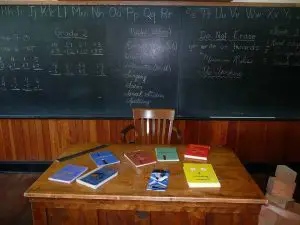
I’m not sure what occurred; the passage of time has obliterated almost all my memories of my two-and-a-half-month stint at Coral Park. All I recall is that my mom was summoned for a teacher-parent conference in the principal’s office. I wasn’t present – but when my teacher and mom emerged, I was told that I was going to attend a new school that would be better for me.
I was stunned by this unexpected turn of events.
Sure, I had noticed that school in the U.S. was hard to adjust to, especially since I was still only beginning to learn English. (If memory serves, Coral Park had no English as a Second Language classes, and the only way I knew what went on in class was because a few of my friends were Cuban-American and tried to translate whenever they could.)
I also couldn’t do much homework yet; my penmanship was awful and I didn’t perform well in math class. Clearly, I needed more help and attention than my Coral Park teacher could give me. And because Tropical Elementary had a large Special Education department with experienced teachers, I was transferred there.
The news that I was going to attend Tropical Elementary hit me like a bag of ice thrown at my face. I had a crush (my first) on a pretty girl with long brown hair named Cheryl. By a sad twist of fate, on the day of the parent-teacher conference, I had finally summoned the courage to write (with help from one of my few friends) a little note with the words “I love you, Cheryl” and hand it to her during recess. Sadder still – she sent me a note that read,
“I love you, too, Alex.”
The only memory that I have of my last day at Coral Park was that it was a cold November day. I was so upset about leaving that I forgot to take a sweater to school. The classroom was warm, but when we went out during recess, I was so cold that Cheryl – my first girlfriend – took off her pink sweater and loaned it to me for the rest of the day.
When I returned it while I waited for Mom to pick me up in front of the school, she hugged me tightly, took my hand, and gave me the first – and last – kiss of our short courtship.


