

“High school isn’t a very important place. When you’re going you think it’s a big deal, but when it’s over nobody really thinks it was great unless they’re beered up.” ― Stephen King, Carrie
Late August, 1980.
The beginning of my three-year stint at South Miami Senior High School was not, shall we say, an auspicious one. Indeed, if I had to choose one word to describe my first day as a 10th grader, it would be “fiasco.”
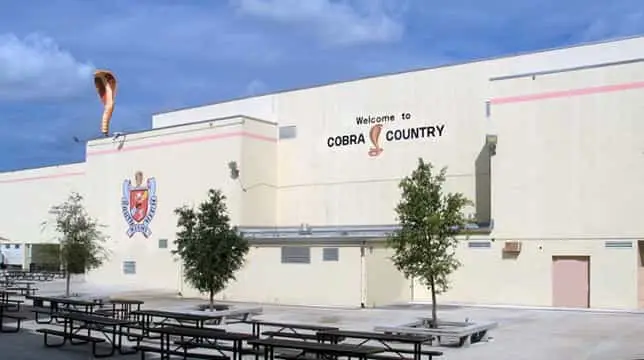
For starters, I wasn’t in the best of moods for much of the day. I hadn’t slept well the night before; my “first day jitters,” compounded by the fact that I was going to a high school where I only knew 10 or 15 students, had robbed me of badly-needed rest. I’d tried hard to sleep, but I was out of bed by 2 a.m., showered and dressed by 3, and out at my bus stop by 5 even though my pick-up time was scheduled for 6:15 a.m.
It was still dark in those early hours of the morning. A handful of stars twinkled in the indigo blue heavens. As the rosy fingers of dawn began to pull back the veil of darkness in the sky, I could see convoys of aspen yellow Dade County Public Schools buses roaring up and down 97th Avenue. Every time one passed in front of me, I wondered if it was the bus that would carry me to South Miami. And at 6:10 a.m., five minutes before my pick-up time, a bus slowed down at my stop, paused….then sped up as if no one was there, leaving me standing in its diesel-stinking wake.
Anything that can go wrong will go wrong. – Murphy’s law
At first, I didn’t think much of it and waited patiently for my bus. 6:15 came and went, and several more buses passed. 6:20….6:25…more buses passed, but none stopped for me. And as the minutes ticked inexorably by, my initial confidence was replaced by a growing sense of alarm. I thought about running home and waking Mom so she could take me to school, but I stayed at my stop with the hope that my bus would show up.
Sadly, the bus didn’t show up that morning, at least not from my perspective. Later that day I was told that my new Special Education bus driver, Mrs. Nolan, was expecting to pick a student in a wheelchair, not one who could walk unassisted although he had cerebral palsy (CP). Thus, when she saw me standing at my stop, she figured that the non-existent kid in the wheelchair was a no-show and drove on to her next pickup.
By 7 a.m. it became clear that I was going to be late to school on my first day at South Miami. Tired, frustrated, and stressed, I walked back to my house and went upstairs to wake up my mom. She was surprised to see me; she knew I had gone to my bus stop an hour early, so she figured I’d be at school by now.
“Alex,”Mom said. “What are you doing here?”
The bus didn’t pick me up. Can you please take me to South Miami?”
“Yes,” Mom said. She was still a bit sleepy; nevertheless, she got dressed quickly and hustled me to her chocolate-brown 1978 Chrysler Cordoba. As we pulled out of the driveway and left our condo complex, I thought I wouldn’t be disastrously late. But I was mistaken: we not only had to contend with heavy morning traffic, but neither of us knew where South Miami High was, As a result, I got to school halfway into Period 2, more than 90 minutes late!
Not only that, but when I reported to the main office, I was told that no one could find my class schedule and to go sit in the auditorium and wait there till further notice. I was so nervous that my muscles’ involuntary spasms became more noticeable as I fidgeted in my seat. I was annoyed, both with the situation and with my CP.
To make a long and tragicomic story short, my schedule was eventually found, and a Special Ed aide named Rochester guided me to my Period 3 business math class. (Of all the courses in all the classrooms in all the world, it had to be math.) Because of the snafu with my class schedule, I arrived 30 minutes late, But Rochester quietly explained to my business math teacher, Mr. King, what had happened, and I was told to take a seat. Within minutes, I was handed a three-page math diagnostic test and told to do as many problems as I could before the end-of-period bell rang, I sighed resignedly, then started working on my assignment.

I don’t remember how much progress I made before the bell (which was more of a hooting horn sound rather than a jingling bell) rang. I do remember that I was struggling with the math problems in the diagnostic test. Not only was I having a tough time solving the problems, but my CP makes it difficult for me to handle pens or pencils for extended periods of time, so my handwriting tends to be a barely legible scrawl that even a chicken would shake its head at it. So when the bell rang, I jumped out of my cramped student’s desk with a mixture of surprise and relief. With my class schedule in my right hand, I walked over to Mr. King’s desk, handed him the diagnostic, then boogied on out of his classroom and into the hallway.
Because I had arrived so late on campus, I had no idea how congested the hallways of a modern American high school get in the five minute-long change-of-period rush. Yes, I was familiar with the routine of going from class to class when the bell rang from my three years at Riviera Junior High School. But that school’s student body of 800 or so pupils was less than half the size of South Miami’s 2100 students.
As a result, I nearly had a panic attack when I saw a teeming mass of teenagers rushing to and fro along a warren of locker-lined corridors and brightly lit classrooms. And if that wasn’t enough, my next class, Newspaper Reporting and Editing A, was on the second floor – and I didn’t know which staircase to take!
If you’ve watched Steven Spielberg’s Raiders of the Lost Ark, which was released shortly before the end of that first school year at South Miami, you probably remember the “basket game” sequence. This is where Indiana Jones can’t find his long-lost girlfriend, Marion Ravenwood, who is hiding from Nazis and Arab thugs in a wicker basket. Indy can hear Marion’s muffled cries for help and knows she’s being carried in a basket, but when he reaches a busy Cairo bazaar, all he sees is a plethora of people carrying nearly identical baskets,
Well, that was exactly how I felt the first time I walked onto the hallway at South Miami. I cringed inwardly when I saw hundreds of my fellow students milling about like an army of angry red ants. How in the world, I wondered, am I going to find the stairs through that crowd?
Fortunately, I managed to get a grip on my emotions and looked around until at last I saw a group of students walking toward an open doorway which led to the main staircase. I gamely followed them up to the second floor and made my way to the Student Publications room.
The classroom was nearly deserted, and for a second or two I thought I was in the wrong place at the wrong time. The only person – besides me, that is – was a kind-looking male teacher with thinning red hair, a somehow bemused expression on his face and a comfortable-looking sweater over casual attire.
I looked at my class schedule and checked the name in the “instructor” column. It said “BRIDGE” in precise computer printout letters. “Um, Mr. Bridge?” I asked nervously.
“Yes,” Mr. Bridge replied. He looked at me quizzically. “Are you one of my students?”
“Yes, sir,” I handed him my class schedule as if to say, See? It says so right here.
Mr. Bridge took a cursory look at the blue and white computer printout, then grabbed a pen from his desk and wrote his initials next to his last name. “Oh, by the way, you better head to the cafeteria and eat lunch. We’re on ‘first lunch’ period, and you have about 25 minutes before you have to be back,” he said.
Although I was still not ecstatic to be at South Miami, the rest of the day was an improvement over its sorry start. I was surprised and pleased when I saw Robert G., one of my non-disabled friends from Riviera in the lunch line; his parents had bought a new house on Miller Drive over the summer, so Robert was automatically transferred from Southwest Miami High to South Miami.
I was also happy when I – unwittingly – met South Miami’s principal, Dr. Warren G. Burchell as I left the cafeteria on my way back to my fourth period class. I had noticed a tall gentleman with white hair and a handlebar mustache standing just outside the cafeteria, holding a walkie-talkie in one hand and occasionally waving polite greetings at passing students with the other. I figured he was an administrator – I had seen Mr. Davis – Riviera’s principal – and Mr, Whatley – Riviera’s dean of students – walking around campus. But I didn’t know who the man with the gray suit and tan leather boots was, so I paid him no mind – until he stopped me in my tracks with a gentle but firm pat on my shoulder.
“Good afternoon, Captain,” the tall mustachioed man said amiably. He referred to the cheap imitation of a U.S. Army jacket I was wearing that day. It was olive drab and bore the insignia of the Americal Division on a shoulder flash and brass captain’s bars on the collar tabs.
I looked at his big friendly face and couldn’t help returning a smile back. “Hi, sir,” I said as casually as I could manage. “I’m Alex Diaz. It’s my first day here.” (Back then, I signed all my classwork and homework assignments as “Alex Diaz” because it was easier than writing my entire last name. I stopped this practice in 11th grade because there were several other students with the Diaz surname and I wanted to stand out.)
“Well, Captain,” he said as he pointed at the bars on my jacket collar, “I’m Dr. Burchell, and I’m pleased to welcome you aboard. I hope you like it here at Cobra Country.”
“It was only high school after all, definitely one of the most bizarre periods in a person’s life. How anyone can come through that time well adjusted on any level is an absolute miracle.” ― E.A. Bucchianeri, Brushstrokes of a Gadfly
I wasn’t sure if I’d ever like being in Cobra Country. My heart was still heavy with sorrow because I knew that I wasn’t going to attend Southwest Miami High or see my Eagle friends again. And I was worried about many things about high school. Would I get along well with the other Cobras? Would I be bullied by students who thought I was a freak or a mentally challenged guy? What if I fell in love with a girl and she rejected me? What if I didn’t do well in my journalism class? What if my teachers didn’t like me, or if I proved to the powers that be that I couldn’t be mainstreamed and was placed exclusively in Special Ed classes?
These were heavy thoughts for a wet-behind-the-ears high school sophomore, and they haunted me even as I rode the bus back home at the end of my first day at South Miami. The only consolation I had as I sat wearily in my seat by the window was that things surely would be better in the days to come.


