

High school is closer to the core of the American experience than anything else I can think of.” ― Kurt Vonnegut
A long time ago in a high school not too far away, I went through the ritual that most of us have gone through: the Quest for the Great Diploma.
And, like many others, I found high school to be a mixture of great joy and sorrow, of accomplishment and failure.
Now, 33 years later, all I have left from my high school years is my kit bag of memories.
Memories.
Oh, man, the memories.
December 17, 1981 – South Miami Senior High
South Miami High had a student population of over 2100 10th, 11th, and 12th graders during my three-year tour there. The school gymnasium was the only large space within the building that had enough capacity to hold everyone – students, faculty, staff, and assorted guests – in one spot, but it had lousy acoustics for singing.
One day after my one-time-only solo performance of Irving Berlin’s “White Christmas,” I joined my fellow Singing Cobras on the school auditorium stage for the second of three scheduled assemblies. I was more relaxed this time as we stood in our assigned places – the sopranos and altos on the right side, the tenors and basses (my section) on the left. I felt comfortable because I was not standing (or sitting) alone on stage with all eyes on me.
All I had to do, I thought, was sing the songs Ms. Owen had selected for our ensemble just as we had rehearsed them. No more solo performances, no more worries, right?
Once again, Ms. Owen led us through our holiday-themed set of Christmas carols, pop songs, and the token musical nod to Hannukah, plus four or five solo numbers. I was sure that I wasn’t going to be called on to do “White Christmas” again; Ms. Owen had coaxed me into doing only one performance, and I didn’t say, “Oh, I want to do another solo,” after the previous day’s concert. I had done my bit for Cobra Country; let others have the limelight.
However, I failed to take into consideration that when Ms. Owen wanted to achieve a goal, she usually found a way. She wanted me to push beyond my comfort zone as a singer because she believed I had musical talent. She also didn’t believe that students should stop trying to achieve great things because of any limitations, real or imaginary.
So it came to pass that as I stood with my fellow chorus singers and waited for the bell to usher in the next class period, I suddenly heard Ms. Owen play the intro to “White Christmas” on the Kawai piano. I froze for a brief instant, but almost a year’s worth of vocal training kicked in and I began to sing:
I’m dreaming of a white Christmas
Just like the ones I used to know
Before I could finish that verse, the bell rang. I looked inquisitively at Ms. Owen. She wasted no time in telling me what to do, though; she just segued to the end of the song, and I just followed her lead:
May your days be merry and bright
And may all your Christmases be white…..
Whether the audience knew that my second solo was a spur-of-the-moment occurrence or not I don’t know. I do know that except for that brief instant of hesitation, I once again channeled my inner Bing Crosby and gave the audience a nice rendition of Irving Berlin’s sentimental holiday ballad, which was a big World War II era hit.
My Yearbook Blues: I Have a Bad Feeling About This
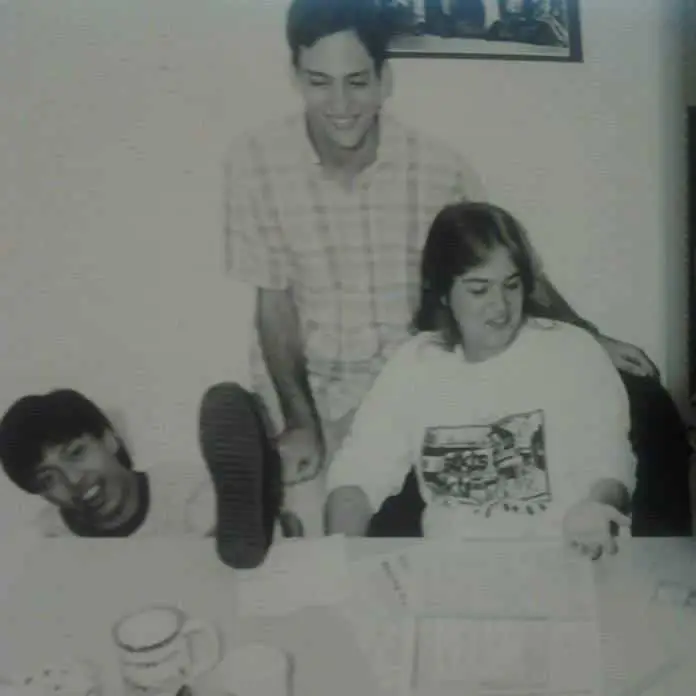
Even as I basked in the temporary limelight of being a member of Ms. Owen’s second period Mixed Chorus class, I was bitterly unhappy with my duties, such as they were, as one of Mr. Gary Bridge’s Yearbook Production students.
It wasn’t that Mr. Bridge was a poor instructor or a strict disciplinarian. Far from it. He was knowledgeable, calm under most circumstances, and willing to help students if they had trouble with a story assignment or needed advice with their page layouts.
He just wasn’t as beloved as some of his peers in South Miami’s Language Arts department; Mrs. Salesky, the teacher he had replaced as newspaper and yearbook adviser at the start of the 1980-81 school year, was revered by students she had taught before I started high school, and Misters Ruppel and Branstetter were far more popular than Mr. Bridge. Maybe it was his calm, businesslike classroom demeanor; we hardly ever heard him crack any jokes in his journalism classes. Or maybe it was because he replaced Mrs. Salesky, but Mr. B was someone that most of his students tolerated rather than liked.
In my case, my unhappiness in Yearbook Production and Editing stemmed from the fact that I didn’t really want to be in the class. I had signed up for Advanced Newspaper Reporting and Editing so I could work on the school newspaper. But the brouhaha over the infamous “censored Christmas issue” had left a bitter taste in most of the underclassmen’s mouths, so only seven students signed up for the class in the 1981-1982 academic year. This wasn’t a large enough number of students in the class roll. As a result, there was to be no school paper my junior year.
I still wanted to be a part of the school’s Student Publications family, so I signed up for the yearbook class, hoping that I’d be able to write some of the copy that would accompany the plethora of photos and illustrations that are the core of any school yearbook. I really didn’t care what section I worked for (I was eventually assigned to the Faculty pages) as long as I could write.
Unfortunately, most of the classwork focused on the design of page layouts, photo selection, gathering lists of students, teachers, staff members, and administrators, and selling ad space and/or reserving copies for the end-of-year distribution. These tasks were necessary, of course, but they were mind-numbingly dull, at least for me.
Worse still, most of the yearbook staffers were lifelong friends who had attended elementary, junior high, and 10th grade together. There was a certain cliquishness that permeated Room 200; it was like wandering into a 1920s speakeasy and not knowing the secret password. So even though I had been at South Miami High for over a year, I felt like an outsider in the yearbook staff…someone who was tolerated more than accepted as a full member of the team.
I was given a few writing assignments – a copy block for this page, a couple of clever captions for some pictures on that page – but nothing really substantial. I think I wrote more words in two articles for The Serpent’s Tale in 10th grade than I did in the entire 1982 DeCapello yearbook.
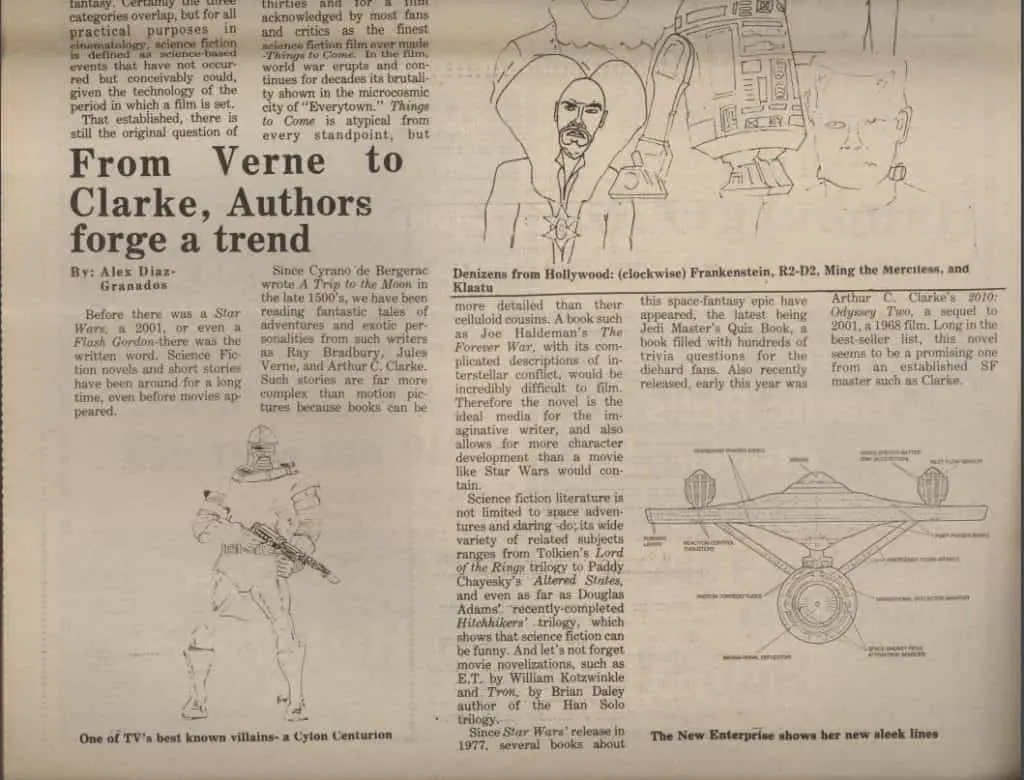
So yes. I was unhappy during my one-year stint on the yearbook staff. In 10th grade I had been a spirited member of the school newspaper staff whose opinion actually counted for something.
Now, in Yearbook Production and Editing, I was almost a cypher. My editor in chief, Lindsey Green, rarely spoke to me, and I was rarely asked to join the various groups of staffers for lunch. I didn’t feel disliked, mind you, but I didn’t feel like I belonged on the staff.
I often wondered if my cerebral palsy had something to do with it; I was shy and introverted then, and I was convinced that the physical manifestations of my disability turned off many people, especially the girls in my classes.
Although the passage of time has given me a better perspective on that period of my life and I’m proud of the work I managed to do for the yearbook, I still can’t portray that experience as a happy one. Yearbook class was the only one that I didn’t care if I returned to from lunch a bit later than necessary, and my final grade – a middling C – reflected my lack of enthusiasm.
As Mr. Bridge wrote in my yearbook:
Alex, it was good to have you in class. I am sorry that you didn’t enjoy the class as much as you had expected. I’m sure that you will have a better time in newspaper next year. Anyway, study hard, keep writing, and always strive for perfection.


